Print-Ready Report
Use Ctrl+P / Cmd+P to save as PDF. Optimised for A4.
Meno — Infrastructure Intelligence Report

Sellafield

Nuclear Decommissioning · 54.4333°N, -3.495°E · Analysis date: 2026-04-13
Comparison: August 2024 (Summer) vs July 2025 (Summer) · Sentinel-2 L2A · 10m resolution

Executive Summary

33.1% anomalous change at Sellafield — the NDA’s primary condition monitoring target

33.1% of monitored pixels (187,984 out of 568,075) show anomalous change. The coastal buffer zone shows the highest anomaly rate (43.6%) driven by coastal erosion and facility-adjacent changes. The NW perimeter shows 39.7% anomalous change consistent with ongoing decommissioning works. The access road area is relatively stable at 10.0% (AMBER), suggesting completed infrastructure.

Key Metrics

33.1%
Anomalous Change
88%
Confidence
88%
Cloud-Free Coverage
12 days
Revisit Cycle

Risk Assessment

RED
Zone DCoastal Buffer
43.6% anomalous · Magnitude: 0.2
Action: Priority inspection within 7 days. Highest anomaly rate — coastal erosion and facility-adjacent changes.
RED
Zone ANW Perimeter
39.7% anomalous · Magnitude: 0.16
Action: Priority inspection within 7 days. Significant perimeter change consistent with decommissioning works.
RED
Zone BCentral Complex
28.8% anomalous · Magnitude: 0.17
Action: Priority inspection within 7 days. Core facility area showing surface modifications.
AMBER
Zone CAccess Corridor
10% anomalous · Magnitude: 0.13
Action: Schedule inspection within 30 days. Relatively stable — infrastructure largely complete.

Satellite Imagery

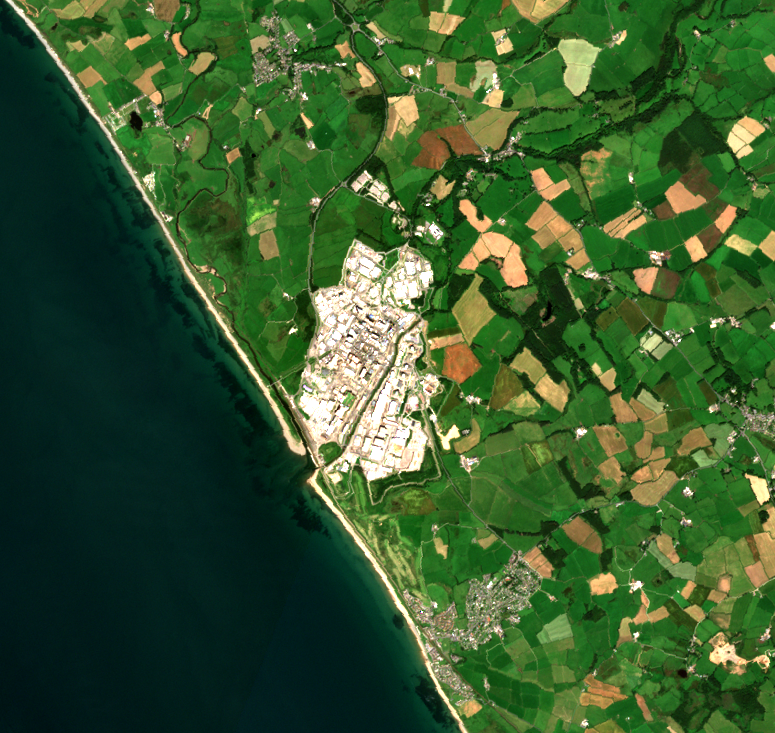
Sellafield — Satellite View (July 2025)
The Sellafield complex (white/grey) dominates the Cumbrian coastline. The scale of Europe’s most complex decommissioning site is immediately apparent from space. Irish Sea to the west, farmland to the east.
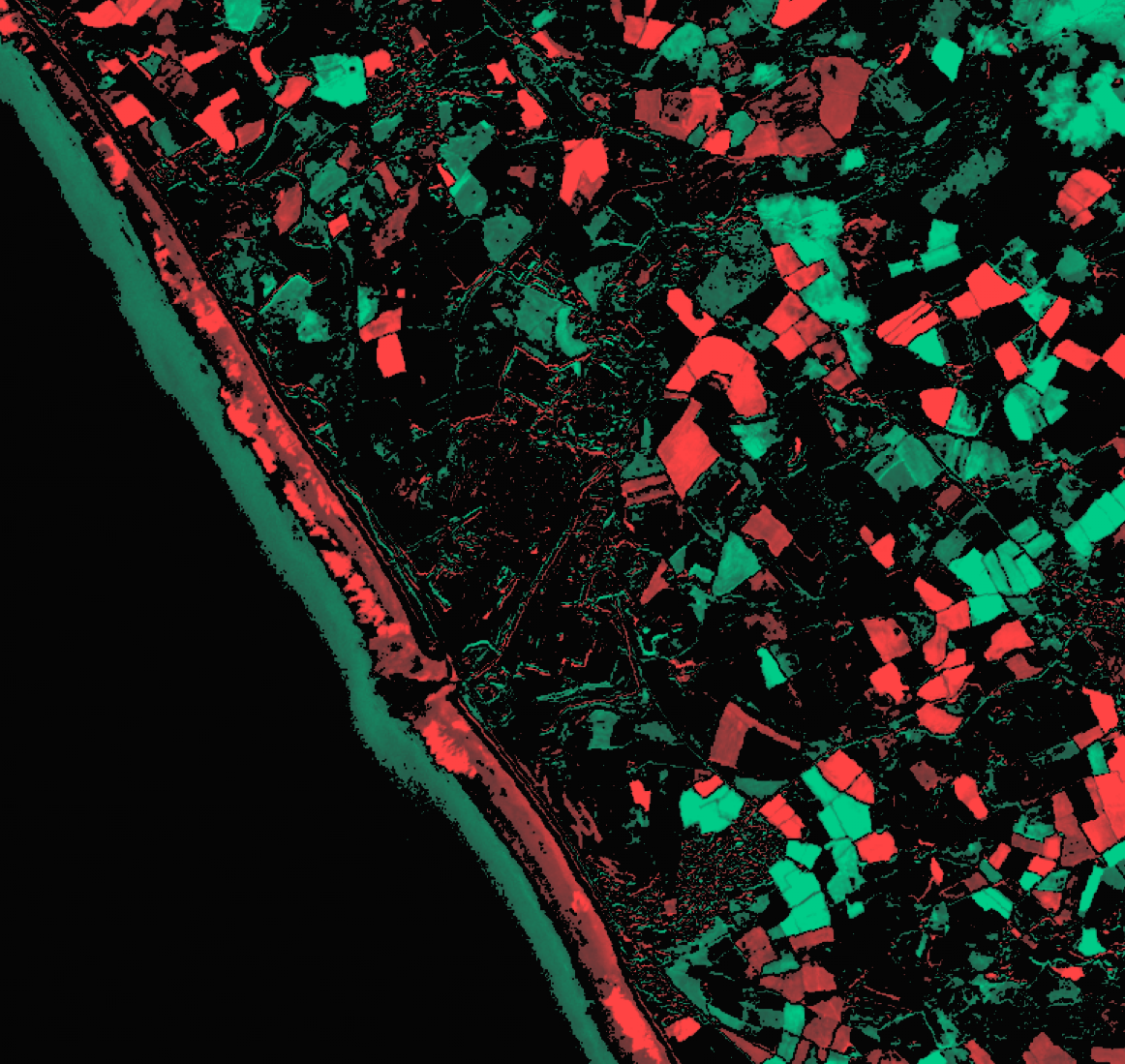
Anomalous Year-on-Year Change
33.1% of pixels show genuine change between summers. The complex itself and its coastal buffer show the highest change rates — consistent with active decommissioning and coastal dynamics.
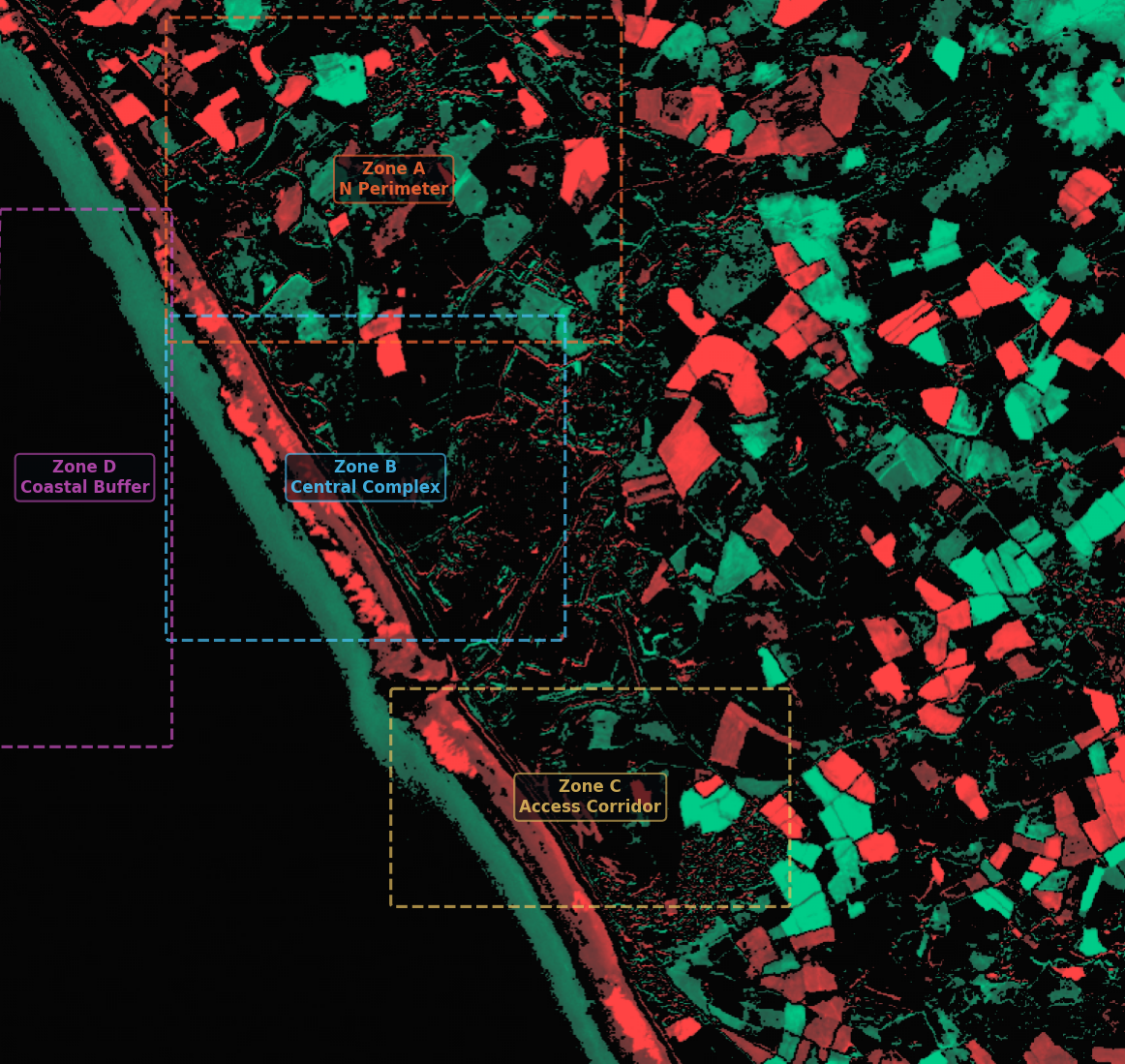
Change Zones — Annotated
Zone D (Coastal Buffer) at 43.6% is the most active. Zone C (Access Corridor) at 10% is the most stable. This pattern is consistent with known site operations.

Methodology

Same-season comparison (August 2024 vs July 2025) using Sentinel-2 NDVI analysis. The 33.1% anomalous change rate reflects ongoing decommissioning activity, facility modifications, and environmental changes across the complex. Anomaly threshold of ±0.08 NDVI isolates genuine year-on-year change.

Confidence note: Good confidence despite T1 scene having 12% cloud cover. Same-season methodology is robust. 33.1% anomalous rate is consistent with known decommissioning activity.

Commercial Value

As the NDA’s primary condition monitoring target, Sellafield satellite surveillance could deliver £150k–£250k annual savings on this site alone while providing 12-day continuous monitoring.

Monitoring Frequency
Quarterly manual inspection
12-day satellite revisit
7.5x more frequent
Annual Cost (Sellafield)
£200k–£350k (manual)
£50k–£100k (satellite)
60–70% reduction
Coverage Completeness
Spot-check (10–15% of site)
100% of monitored area
Full site coverage
Detection Latency
3–6 months between inspections
12 days
90%+ faster
Procurement Alignment
NDA ITT closes Apr 2026
Discovery Phase capability ready
Positioned for bid

Strategic Implications

Sellafield is the direct procurement target for the NDA’s £4.9m Condition Monitoring pipeline. This analysis demonstrates that satellite monitoring can detect and quantify decommissioning-related surface changes at the site, providing continuous 12-day oversight between manual inspections. The ITT closes April 2026 with award expected July 2026.

Procurement target: NDA £4.9m Condition Monitoring pipeline · ITT Close: Apr 2026 · Award: Jul 2026
Meno — AI-Powered Infrastructure Intelligence
AS9100 Quality Framework · CAA Orbital Compliance
Discovery Phase v0.1.0
Generated: 2026-04-17